June2026

BOAT NEWS
Bob Hicks, publisher of MESSING ABOUT IN BOATS, where this blog originated as OVER THE HORIZON, passed away recently. The magazine was one of the last printed editions dedicated to small boating and those of us who like to mess around. Bob was a mainstay in journalism, a friend, and a man of importance. He will be missed.
SAILING WORLD, the magazine oriented for globe-trotters, has folded. Evidently, the cost of printing, mailing, logistics, salaries, and the rest, simply does not a profit make. I used to subscribe to just about everything boat-oriented, if only to drool at the photos; unfortunately, my mailbox pretty much is empty of boat magazines. I find this truly sad.
WOES
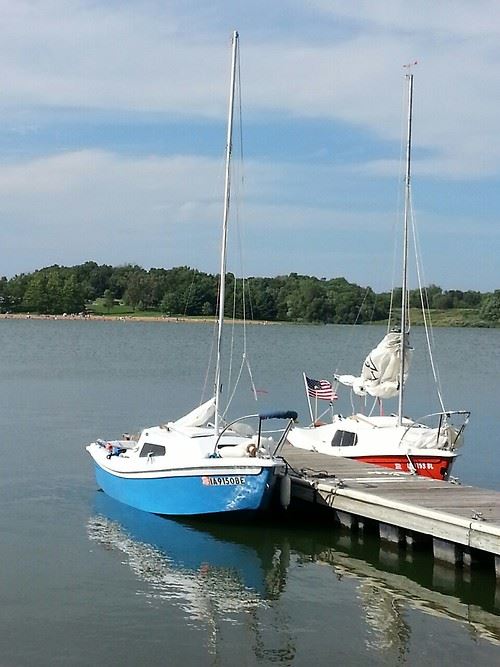
My 78-year-old body is in full ache mode as I have attempted to get my beloved WWP-15 GENNY SEA and the pontoon, GREYBRIAR, into or near water. Iowa decided to skip spring this year and held onto a lengthy cold spell until mid-May. Even my lilacs did not bloom this year.
The sailboat needed some minor repairs and a good paint job on the hull. Ready to pick it up from storage, I discovered that one of my tires as bald as my late father. With 4-wheel drive vehicles you need to buy not one, but 4 tires; furthermore, since the other 3 looked pretty good, it was apparent that my wheels were not aligned properly and the tie rods weren’t tied well (my mechanical knowledge is in the negative numbers), all of which put my mission on hold and a $1600 deficit in my pocketbook.
The sail boat took significant cleaning before I sanded the hull and filled little dents. Painting was not as difficult as I imagined but some spillage on the driveway, some odor of thinner in the house, several used brushes and rollers placed in unacceptable locations, and that was done. Lake McBride (another of Iowa’s manmade wonders) was open for dry slips and my boat was appropriately deposited next to two 24-foot PRECISIONS that haven’t seen water in a couple of years. Surprisingly, my wife assisted me raising the mast before we discovered that I’d forgotten to put in the lines. The attempt to lower the mast bent the quick-link and Jesus couldn’t unhitch the mast. The next day, I went back to Solon with my hack saw and a new link. The following day (Day 3, if you’re counting) I went back to finish inserting the battens and remembering a battery for the trolling motor.
THEN, it was time to deal with the pontoon. After bringing the beast home for cleaning, waxing, etc., I found out that the City of Cedar Rapids had not put in the harbor docks yet. I finally went down to the river to pray… no, to put the boat into the brackish Cedar River. The canvas cover had been ripped to shreds in the wintery blasts, and, after paying for the car tires I decided not to buy a new tarp, and made a mad dash to Walmart for iron-on patches (which takes about a good hour of driving, finding a parking place, wandering around the store, and checking yourself out).
I took the pontoon down to the river, puttered over to my slip, and tied her up. I usually put in a couple of old tires to keep from bumping into the concrete wall; unfortunately, the city had welded a different thing to the dock so my incredibly creative procedure of attaching the tires to the wall was worthless. The uncovered pontoon enjoyed a nightly storm and is an equivalent of a trailer-court-trash-looking boat. Maybe tomorrow, Day 9 of my efforts, I will finally find a way to get a tarp on the boat…after I clean it up.
The good news is that I found my lost house keys, totally messed up my cell phone so I don’t get any SPAM calls, and I have survived—thanks to many adult beverages at the Tic Toc.
COAST GUARD
Without any fanfare or concerns by the press, the Current Administration eliminated 12 of the 45 Coast Guard Admirals for reasons known but to God. The Coast Guard (whose Commandant was fired by Mr. Trump) and the White House have been at loggerheads over its role, with the former believing that its mission is navigational directives, merchant marine licensure, immigration suppression, and maritime safety, while the White House wants the Coast Guard to be more War Department oriented. The Navy drools over the desire to move the Coast Guard to the War Department so it can get its paws onto the Guard’s budget.
The Coast Guard has already voiced opposition to the Administration’s moving licensure and merchant ship inspection to third parties (read that: “friends of Mr. Trump.). This kind of governmental game of checkers not only is unprecedented but it has left America inured to wheeling and dealing.
The administration is asking Congress for money to construct a maintenance base and fuel depot in the Philippines for their Coast Guard to add protection against China who constantly harasses the PI’s Coast Guard around the Spratly Islands that both countries claim. The Filipinos currently have resources on Palawan; however, the U.S. feels added military facilities are necessary. It is important to remember that the U.S. Navy has been planning for a war with China within the next twelve months, and China has prepared for a war with the U.S. during 2027. Beware of what you wish for!

GRAY FLEET
Operation Epic Fury has cost approximately $29 billion as of mid-May. The expenses have greatly exceeded the initial planner’s projection; however, the side-effects of the fiscal trauma has wide-spread implications. The Navy, as well as the other service branches, have been hard-pressed to maintain new enlistments quotas. The financial deviation of money created a need to delay promotions among current personnel and reducing monetary awards for re-enlistment. The paucity of available crew has increased because over 15,000 personnel who have enlisted but have not reported to Boot Camp have been placed on hold because the Navy can’t pay them.
During the waning years of the Viet Nam War, the Navy had too many sailors then needed, especially in certain billets such as Vietnamese linguists. I had graduated from college in August of 1969 and was sworn in as an E-3 one month later. Due a total lack of mechanical ability, physical stamina, or mathematical intelligence, they decided I should be a Communications Technician (now called Cryptological Technicians). Unfortunately, they really did not need me and I was placed in a series of excess billets (read that: swab decks, clean heads, and completing the beloved task of washing dishes and cleaning pots and pan for 30 days (at Christmas and New Year’s Day as a Mess Cook). While the CT rating previously had been limited only by time-in-rank, by 1970 all CT promotions were on hold. For three years I slaved away as an E-3. I knew enlisted Lawyers, PhDs, and a plethora of Master’s Degree men who never made E-4 ( in some cases, it was reverse snobbery. They refused to take the test for promotion as they thumbed their noses at the Navy). BTW: the attorney who refused a commission because of the war, made a ton of money doing taxes for officers. My XO told me he would be so very happy to see us leave the Navy.
Don’t you just love Washington, D.C.? A mentioned before, ad nauseum, the Navy had this brilliant idea of building one hull and playing LEGO with the superstructure so that hull could be used for a plethora of configurations replete with the highest technology available at any one time.
The LCS was so brilliant a scheme that industrialists drooled copiously and inundated Congress with colossal levels of fiscal donations to “bring home the bacon”. In their comprehension of local business means re-election, Congress decided that not one hull, but two completely different hulls were required—one looking like most ships and one a trimaran.
Predictably, the quite revolutionary motors and sundry generators failed to work properly on either type of ship, and the first several packages could hardly leave port. Then, weaponry technology evolved faster than shipbuilding, and the LCS’s missions disappeared quickly. However, building ships was a Trump priority, and the ship construction with all the featured gadgets continue to be assembled.
A new FREEDOM-class LSC, the USS CLEVELAND LCS-31 was commissioned recently with much ado and fanfare complete with Congressmen, Senators, and a Midas-level of Gold Braid. Meanwhile, the Navy decommissioned 7 (yup, 7) of the FREEDOM-class LCS ships and two of the INDEPENDENCE-class about 20 years before their projected lifespan.
Wasn’t Elon Musk supposed to cull governmental waste and inefficiency? “The program is widely regarded as a failed, costly effort, with premature retirements (sometimes only 5-11 years into a 25-year life) and significant mechanical issues, particularly with the Freedom-class combining gear”, is the official statement. Yet they continue to build them!


HISTORY
While the story has been re-told in this blog, the tale of the SULTANA remains tragic, interesting, and significant. The side-wheel packet was built in 1862 in Cincinnati with a wooden hull of 260×42 powered by Moore and Richardson engines 25” pistons driven 8’ via steam from 4 boilers pushing 34’ wheels with 11 buckets.
During the Civil War, operation was risky, so instead of the Mississippi route she ran on the Ohio River, but even that was cut short because her stacks were too tall for the Wheeling, WVA bridges. She then floated between Cairo and Memphis, and later between St. Louis and New Orleans. She was purchased by a consortium of investors.
A week after the assassination of President Lincoln, SULTANA was ordered to stop at Vicksburg to pick up prisoners of the infamous Rebel Andersonville camp. Even though it was authorized to carry 370 people, the captain looked at the Army’s offer of $5 for enlisted men and $10 for officers, and he permitted 2,500 men aboard.
The weight of all the men caused the boat to rock from side to side as the passengers moved around on the deck. A few miles above Memphis, the overworked boilers exploded killing 1,547 of the just released prisoners either in the initial blast or drowned because they could not swim. Naturally, fingers pointed to an amazing array of potential perpetrators including the 2nd Engineer Samuel Clemons who was on watch and Chief Engineer Nathan Wintriger. The first inspectors claimed the boilers were low on water and blew up. They revoked licenses but quickly reinstated them. The Army blamed Captain Fredrick Speed for allowing so many men on board, but they soon exonerated him.
The wreck itself, was discovered 42-feet under an Arkansas soybean field over 2 miles from the present river. It was decided to leave it undisturbed as a memorial.
(Story thanks to Captain David Smith in Waterways Journal).

ALLISIONS AND COLLISIONS
COURAGE C, a Vanuatu-flagged cargo ship displacing 1,939 tons managed to slam into rocks and sink. Her crew of 9 were rescued.
HAJI ALI, hailing from India, was sunk by drones near the Horn of Hormuz.
GALAXY LEADER a car carrier with a Bahamian flag was captured by Houthi rebels but they were unable to make much from such as pirating act because the Israeli Air Force promptly sank it.
SMALL BOATS
SAIL Magazine looked at several small boats, selecting their perception of the Top 10, and featured them nicely this month. The variety of boats shown indicate the rise of technology and significant new marine concepts.
The STORM 18 is a fractional sloop with a raising bulb keel that was designed for racing and probably needs at least 2 to sail her. She is low and flat with a mere whisper of a transom. Certainly, this isn’t your father’s dinghy.

BIRDYFISH IODE has brought foil sailing to the small boat folks, and while the experts she is decidedly easy to sail, the concept of aerodynamics in sailing seems foreign. She has 2 G foils and a T rudder that assists in reaching speeds of 20-25 knots. It looks like a flat plastic sled that costs over $13,000 but it warrants an examination.

A third model is the HAPPY CAT STAR, an inflatable catamaran mixed with carbon fiber supports and a foldable mast that is easy (sure!!) to assemble and disassemble. At 15’9” by 7’5”, this petite gem can be folded up and placed in bags that will easily fit in your trunk. The whole concept seems crazy to geezers like me.


